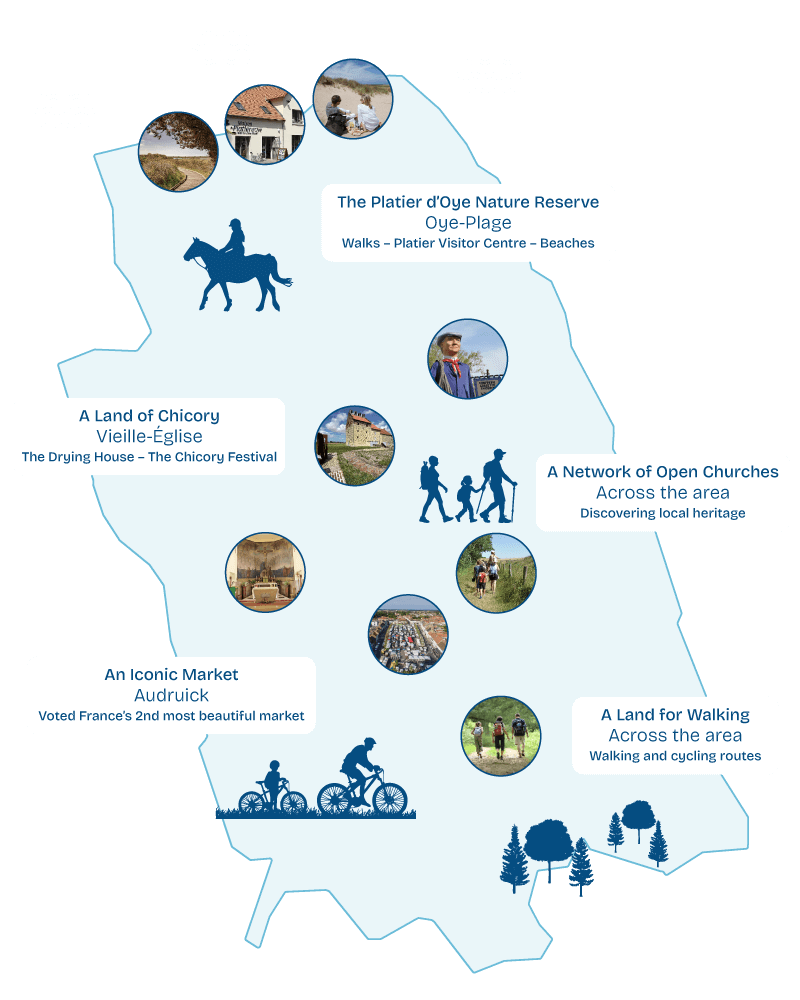
A Land of Chicory
Water, sand, and wind
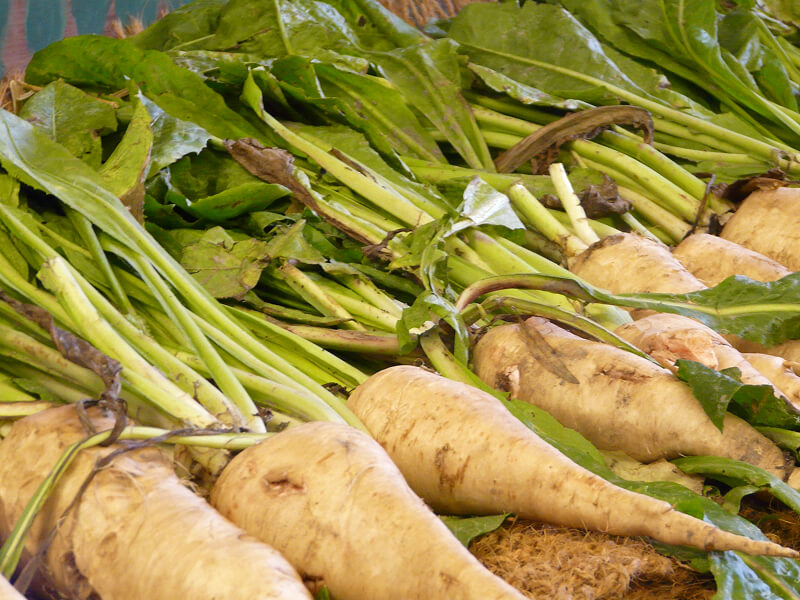
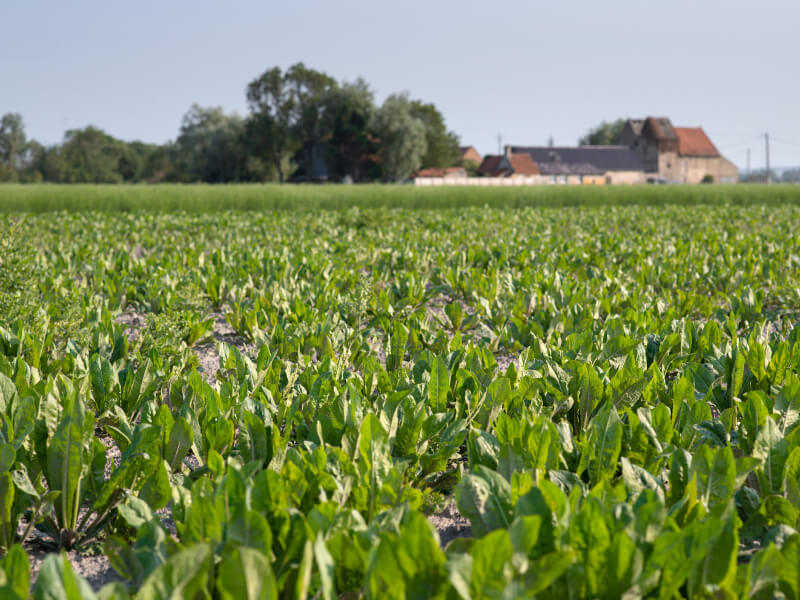
Since the end of the 19th century, chicory cultivation, mainly present in the Orchies region, reached the Opal Coast. In the heart of the Aa delta, between Calais and Dunkirk, on land reclaimed from the sea, the sandy substrate is ideal for growing chicory roots.
The importance of the water network (the “Wateringues”) and the constant winds also facilitate the operation of the drying kilns.
While it reached its peak in the mid-19th century, chicory cultivation still holds an important place in the local agricultural and economic activity.
Did you know? ¼ of the world’s chicory production comes from the Audruicq Oye-Plage region.
Chicory, our local spice
The Audruicq Oye-Plage region, polder of the Porte d’Opale, is the most significant chicory production region in France. It produces, dries, and processes nearly 20,000 tons of roots per year.
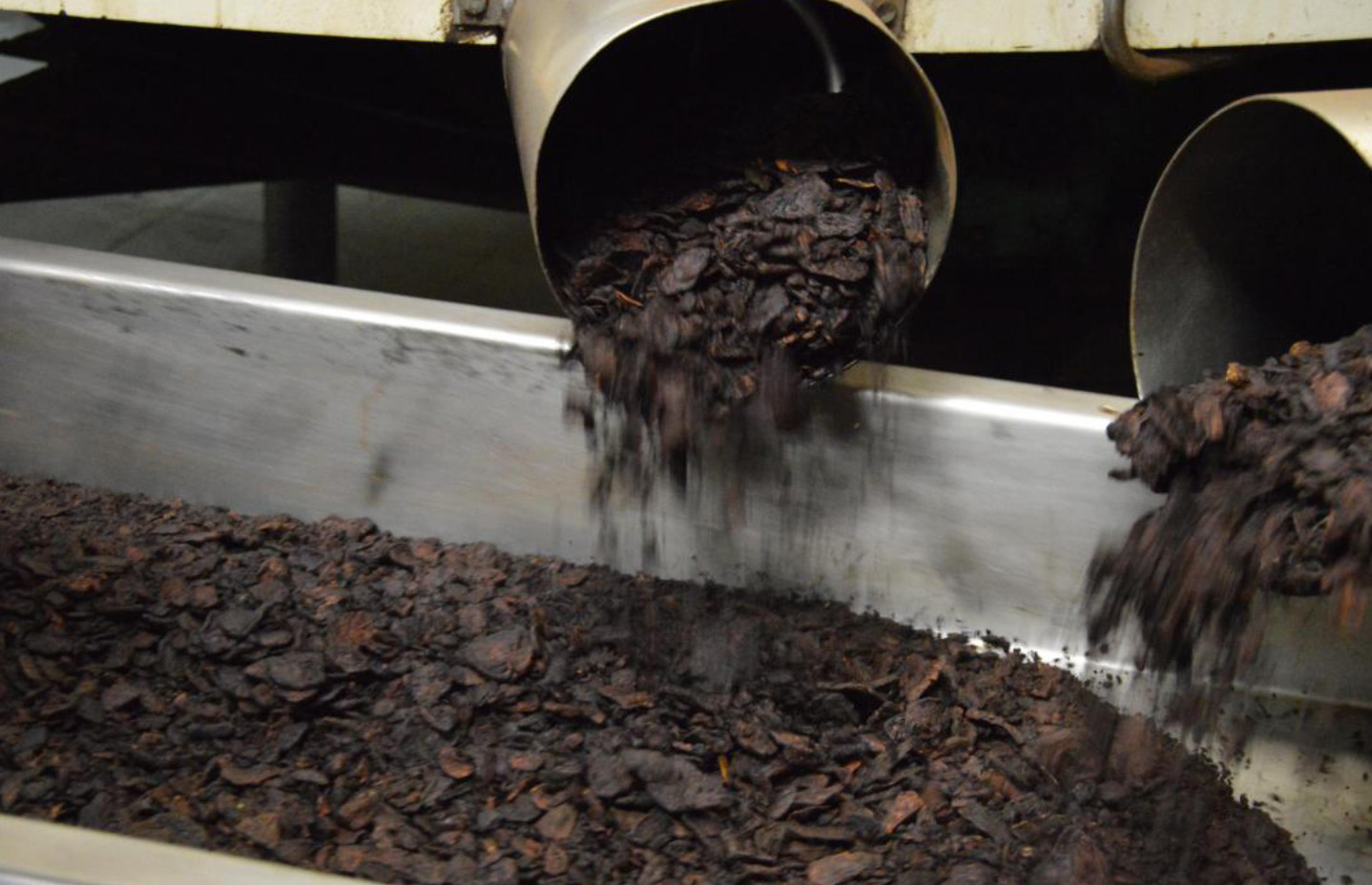
Today, chicory roots are dried in the ovens of the LEROUX establishments in Vieille-Église and SONODE in Saint-Pierre-Brouck on the other bank of the Aa. These are the last two industrial drying plants in France that have replaced artisanal dryers.
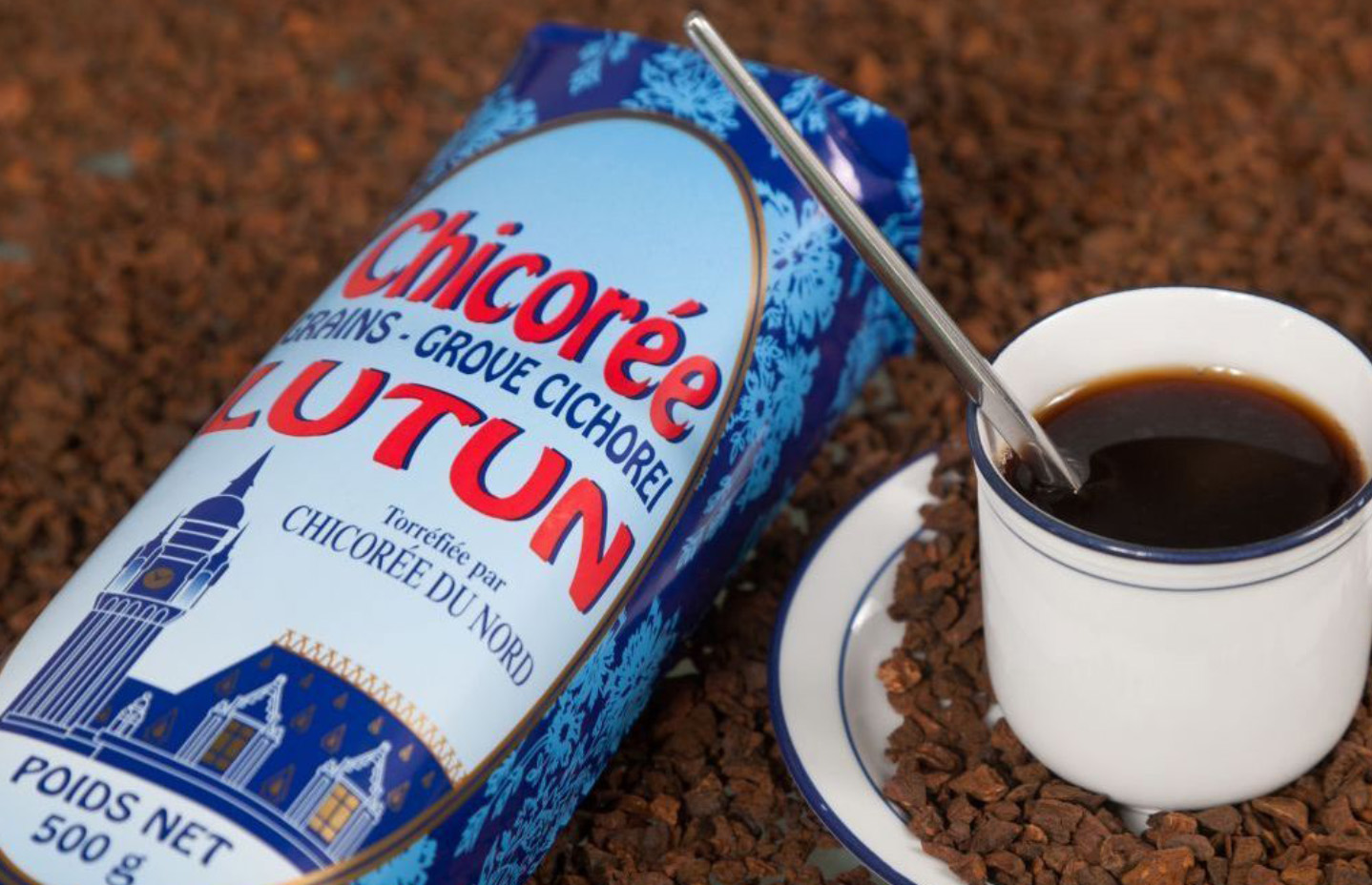
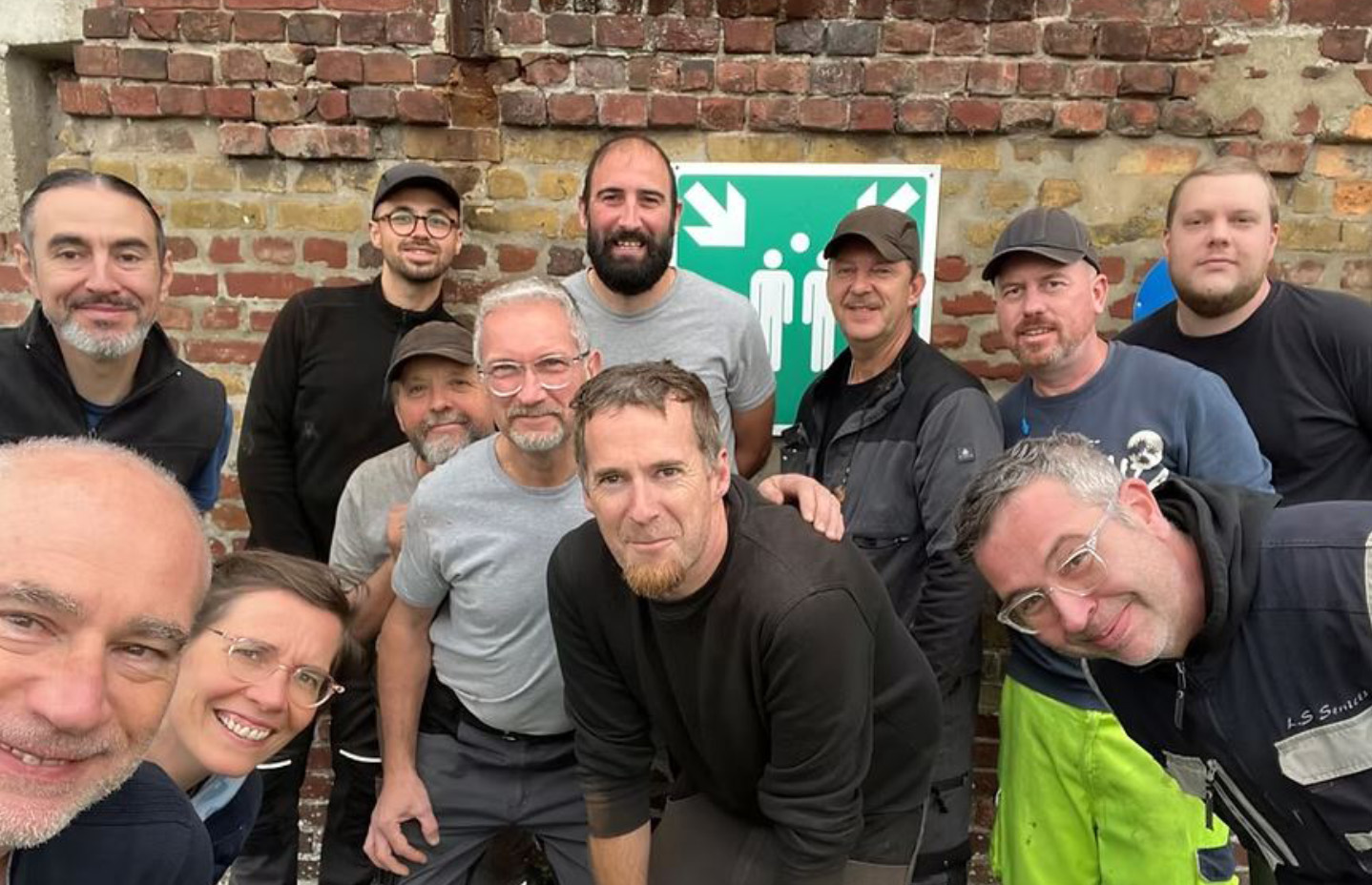
The sliced roots (cossettes) are then roasted (caramelized), crushed, or infused. Locally, the family factory “CHICORÉE DU NORD” in Oye-Plage, the second-largest chicory roaster in France, produces a range of chicory in grains, liquid, or paste, ready to be consumed..
Primarily used in food, chicory is also used in the production of inulin, from which a sweetener and dietary starch are derived.
In recent years, chicory has also gained recognition in the culinary world. A flavor enhancer, it also contributes a diverse aromatic palette: flavors of roasted grains, coffee, a gentle bitterness, and notes of caramel and mild smoke.
Chicory, quite a story!
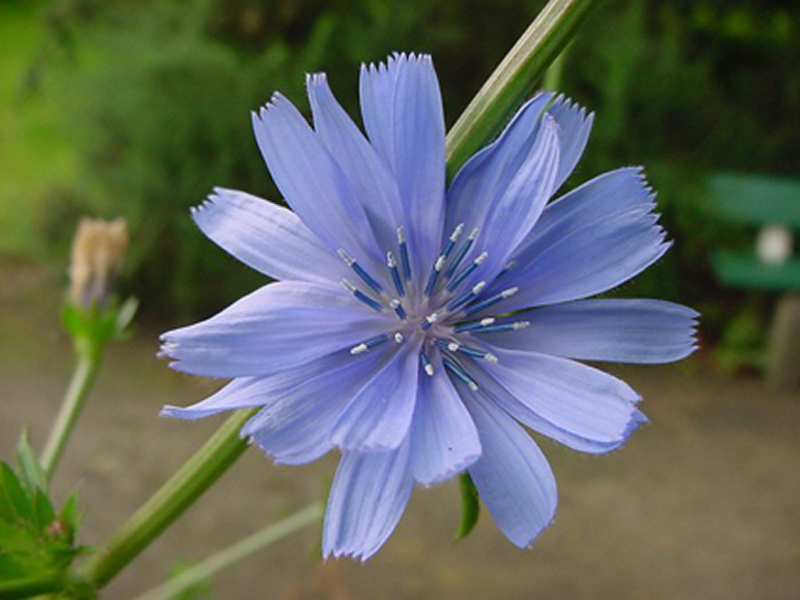
The bride of the sun
The chicory plant, Cichorium intybus, bears the beautiful name “Bride of the Sun”.
Following the rhythm of the sun, it blooms and opens dark blue in the morning, pales at noon, and closes white in the evening. Thus, Ovid in his Metamorphoses evokes the legend of Elytra: a young woman who, abandoned by the Sun God, transforms into a chicory flower to follow her beloved’s flight in the sky with a melancholic gaze. The flower has become a symbol of faithfulness.
Chicories (Cichorium) are a botanical genus comprising plants of the Asteraceae family. This genus includes both wild species and cultivated plants: either leaf varieties (salads, endives) or root varieties (a coffee substitute known as chicory).
From Egypt to the Maritime Plain
Coffee chicory is a varietal type of large-rooted bitter chicory. It appears in Pliny the Elder’s Natural History, which mentions the presence of the wild plant in Egypt, where its aperitif qualities were recognized, and notes its medicinal properties. Galen called it the “friend of the liver.”
Chicory was cultivated in Europe as a medicinal plant during the Middle Ages. The use of chicory as a coffee substitute first appeared in the Netherlands towards the end of the 17th century, then spread throughout Northern Europe: England, Prussia, Belgium, and France.
It experienced a real boom, particularly in France, during the Continental Blockade of 1806. Napoleon I, attempting to ruin the United Kingdom by preventing it from trading with the rest of Europe, caused a coffee shortage. Roasting the root then made it possible to obtain a drink considered superior to the decoction of dried root previously in use.
Humain and technology
Know-how shared between France and Belgium
Work and Prosperity
Chicory cultivation appealed to local farmers as early as the late 19th century, leading them to become planters and subsequently dryers. They relied on the expertise of our Belgian neighbors and friends for the construction and operation of the drying kilns. Every year, French planter-dryers thus called upon Belgian seasonal workers, mainly from Lichtervelde, a municipality in West Flanders near Bruges.
Chicory-related activities set the pace of village life throughout the seasons. From weeding and thinning in the spring to the root harvest in autumn, when the drying kilns ran at full capacity, filling the countryside with a sweet, caramelized scent.
From field to drying shed
From October to mid-November, men and women harvested the chicory roots by hand using a tool called a “fourkète” (a specific fork). They remained bent over for entire days to extract the roots one by one. Using a “chicory knife,” the leaves were then cut off. Loaded into horse-drawn carts called “tombereaux,” the roots were taken to the drying kiln.
At the drying kiln
Work in the drying kilns was carried out by Belgian seasonal workers who had mastered the root drying process.
For about three months, they worked 18 hours a day in intense heat—a sharp contrast to the autumn chill—bare-legged, dressed simply in a linen skirt and wearing wooden clogs. They lived within the drying plant itself, in what was known as “the Belgians’ room.”
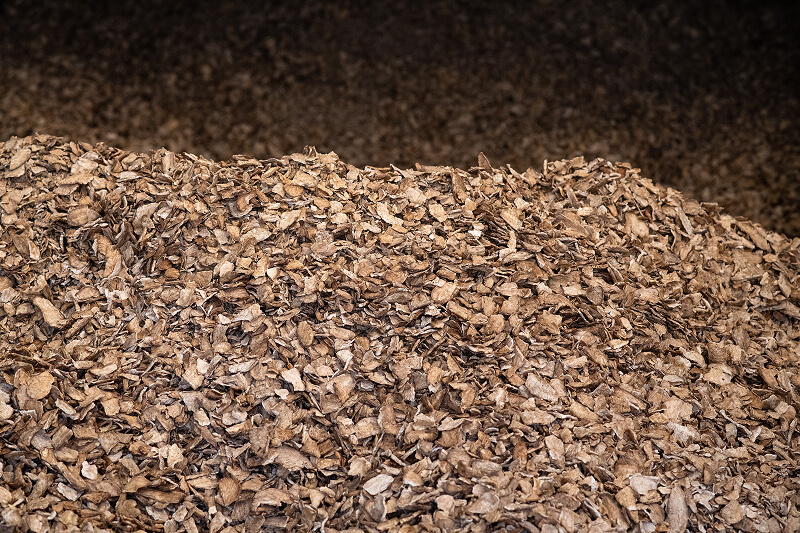
The roots were first washed with water from the wateringues (drainage channels) and then sliced into strips, called “cossettes,” using a root cutter. They were then transported by a bucket conveyor to the highest of the building’s three levels (called platines). Over a period of 24 hours, they were successively spread onto the floors of the lower levels. Under the heat of the coke fires, the chicory lost up to 75% of its weight, sending thick clouds of steam escaping from the chimneys. The dried cossettes were then stored in the “cossette storehouse” before being transported for roasting.
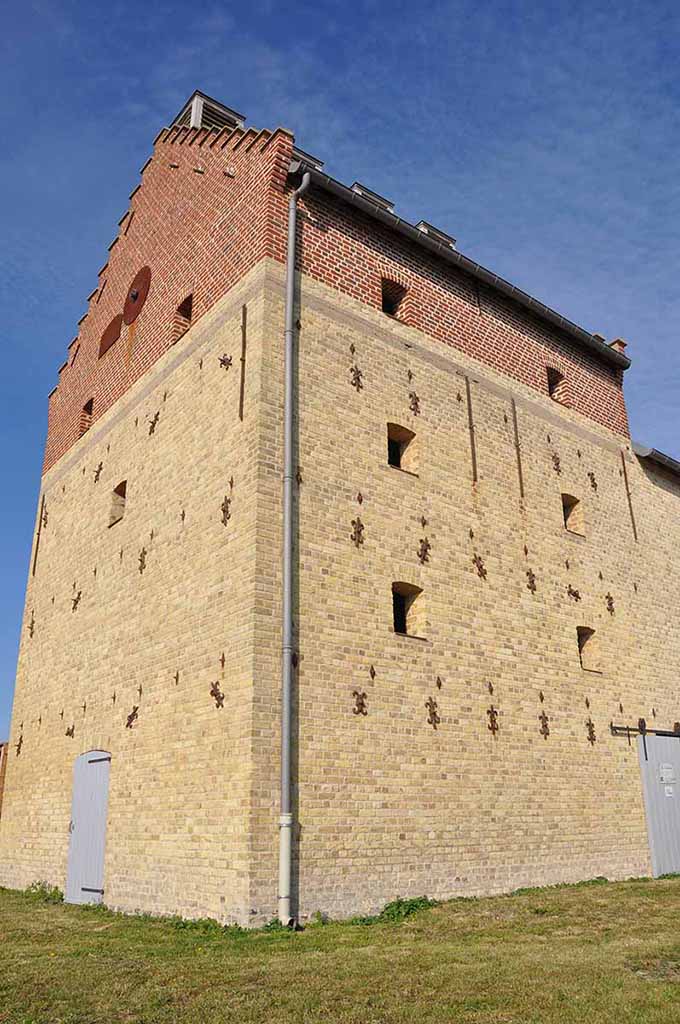
At the beginning of the 20th century, there were more than sixty brick drying kilns in the maritime plain. Around thirty buildings still stand today as witnesses to this major agricultural activity. We like to call them our “Cathedrals of the Plains.”
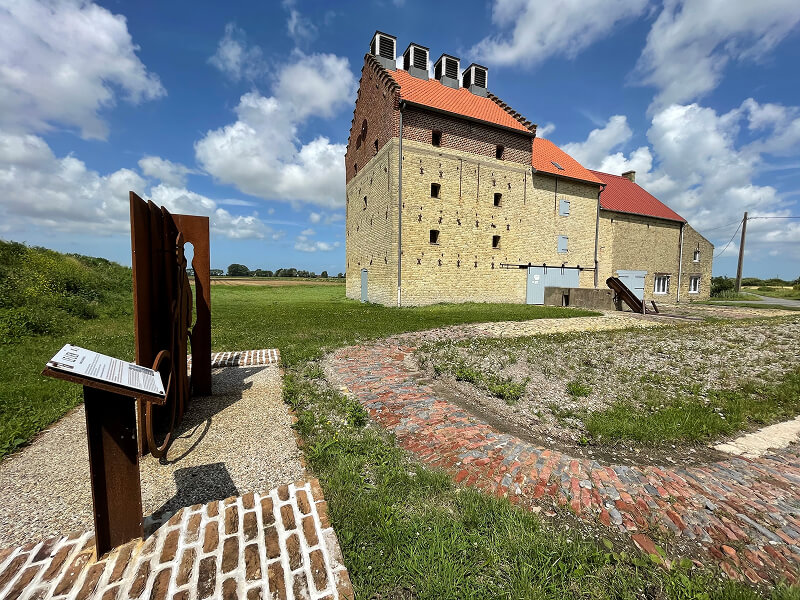
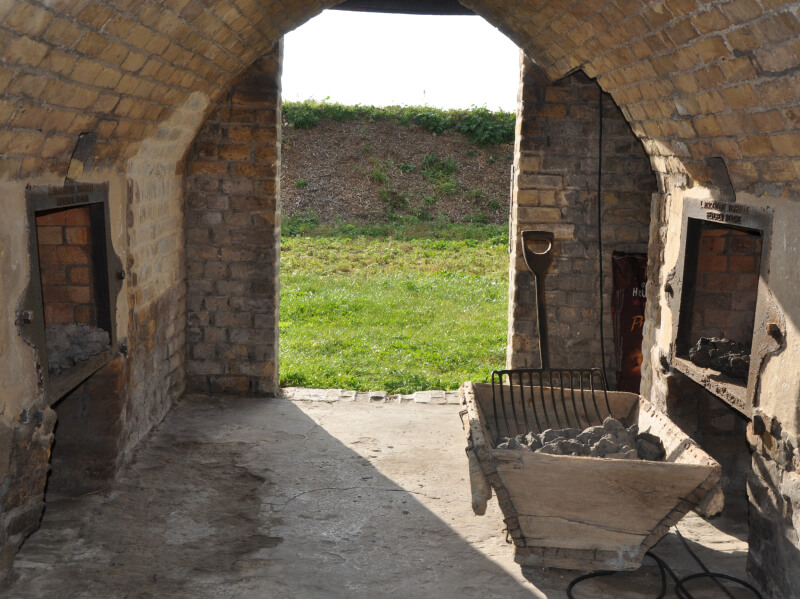
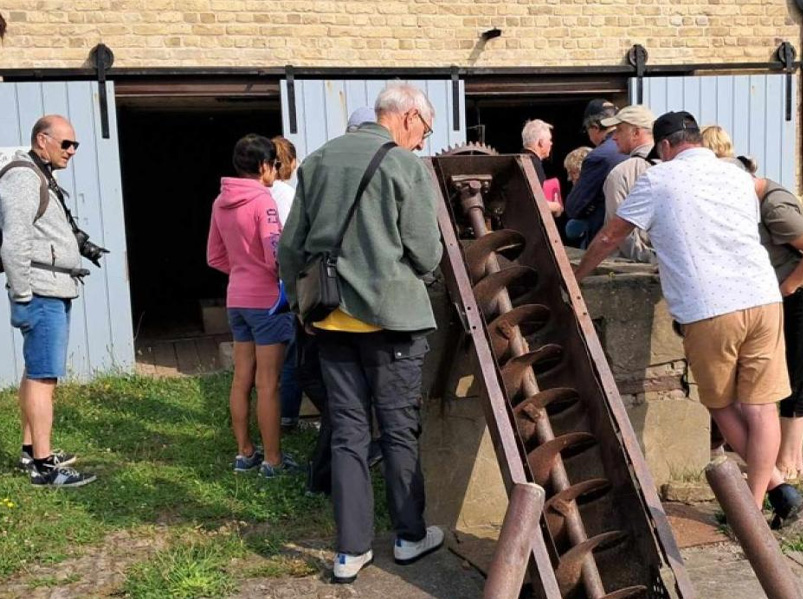
Did you know? In Vieille-Église, a small village between Audruicq and Oye-Plage, stands the only artisanal drying kiln in France restored to its original state.
Guided tours are organized there!
To discover chicory country
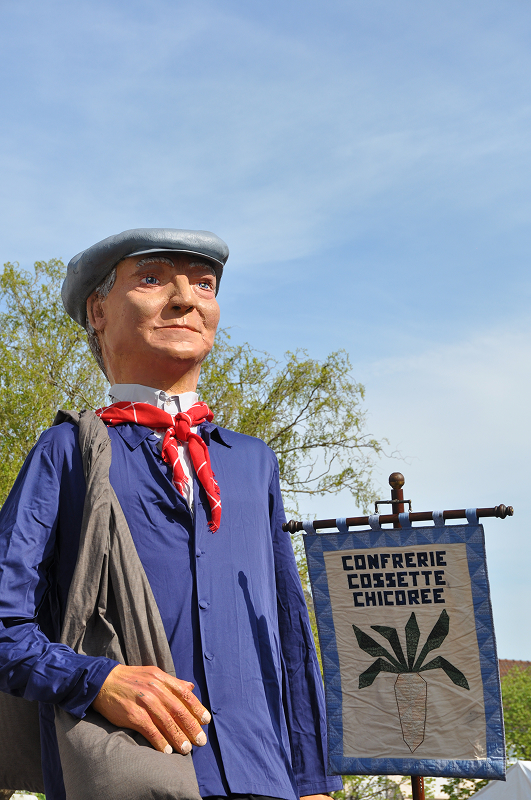
The “Des Racines et des Hommes” (Roots and Men) association, with the support of the CPETI and the Community of Communes of the Audruicq region, orchestrates this event which has become an unmissable highlight for the territory. Street theater, the parade of the Giant “Albert the Dryer”, the procession of the “Brotherhood of the Coffee Cossette” , the gastronomic fair “Chicory in the Kitchen!” , and visits to the drying kiln.
For a whole weekend and beyond, residents, associations, artisans, and chefs come together to showcase coffee chicory, an essential ingredient of the Hauts-de-France terroir!
The touring route:
In the land of Wateringues and chicory
Do you know about wateringues and watergangs?
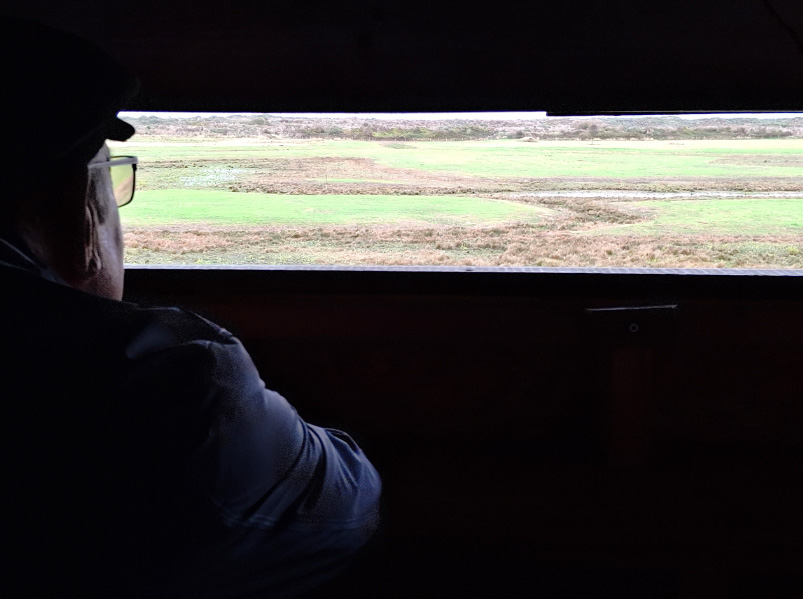
This tour will teach you far more than any geography class! Between the Artois highlands and the Maritime Flanders lowlands, set off to discover a landscape shaped by water.
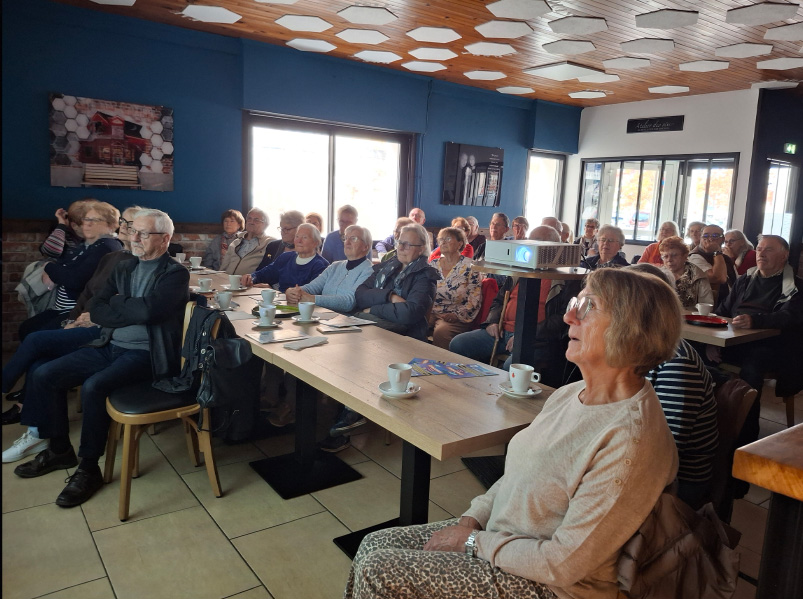
After a tasty lunch featuring local products, it’s time for another local treasure: chicory, the region’s iconic pride. We promise, after this day, you’ll never run out of stories to tell on the subject!
Chicory: Top places
Throughout our region, restaurateurs and culinary creators use chicory for original savory and sweet dishes. Food artisans such as bakers, butchers, and pastry chefs are incorporating chicory into their creations. In cakes that have become local specialties like “L’Audruicquois,” in cookies, tarts, macarons, and meringues; in cheese, bread, jams, terrines, or beer… chicory is everywhere!
Chicorée du Nord
France’s last artisanal chicory roaster
493 route de l’Étoile – 62215 Oye-Plage
In our territory
The bakeries
Le pain de Sébastien
316 place du Général de Gaulle
62370 Audruicq
Boulangerie Pâtisserie Thedrel
95 place de l’Union Européenne
62215 Oye-Plage
Le fournil des Deux-Églises
185 rue du Fort Bâtard
62162 Vieille-Église
Aux délices de la place
128 place du Général de Gaulle
62370 Audruicq
Boulangerie Nicolas&Élodie
128 rue de Calais
62215 Oye-Plage
Boulangerie Vandewalle
85 la Place
62370 Zutkerque
Boulangerie Au moulin
7 rue Georges Mauffait
62370 Audruicq
Au fournil d’Eve
52 rue de la Gare
62370 Ruminghem
The groceries stores
Natur’Pom
9 rue de la Chapelle
62370 Nortkerque
Les Saveurs de Claire
326 place du Général de Gaulle
62370 Audruicq
Les Cafés du Père Jaco
125 avec Paul Machy
62215 Oye-Plage
More…
Fromagerie des 2 caps
11 rue Calmette
62720 Réty
Biscuiterie Sophie Farrugia
7 rue Jean-Marie Bourguignon
62930 Wimereux
Fleur de Sel des 2 caps
1872 rue de l’écluse carrée
62730 Les Attaques
Fromagerie Maréchal Huchin
109 rue des Hauts Champs
62137 Coulogne
Les Gaufres de Nath
16B rue de Remilly
62380 Wavrans-sur-l’Aa