
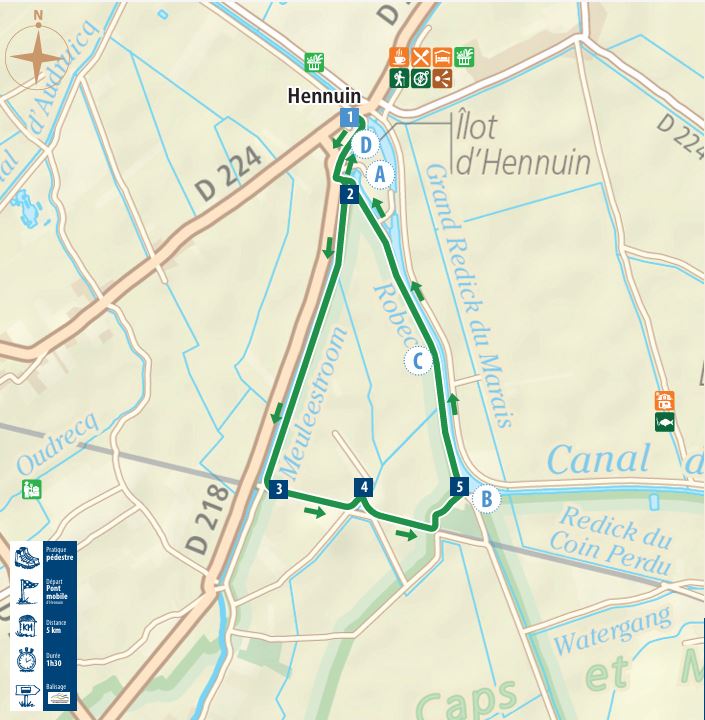
Around Hennuin Trail

Practical information
Walking

Start
Hennuin Swing Bridge

Distance
5 km

Duration
1h30
Wildlife and plant life of the watergangs
Watergangs, as well as canals and ditches whose routes are often lined with pollarded willows or reeds, are home to a rich and impressive variety of fish. These include predatory species such as pike, zander and perch, as well as ‘white fish’ like carp, roach and bream.
During your walk, you may also come across a moorhen, easily recognisable by its red bill, or spot the grey plumage of a heron feeding on fish or small mammals. By observing the banks, you may also notice signs of the muskrat, a small animal native to North America that was once sought after for its fur.
Today, active from dawn until dusk, it unfortunately weakens the banks of the watergangs.
Don’t miss this during your walk!
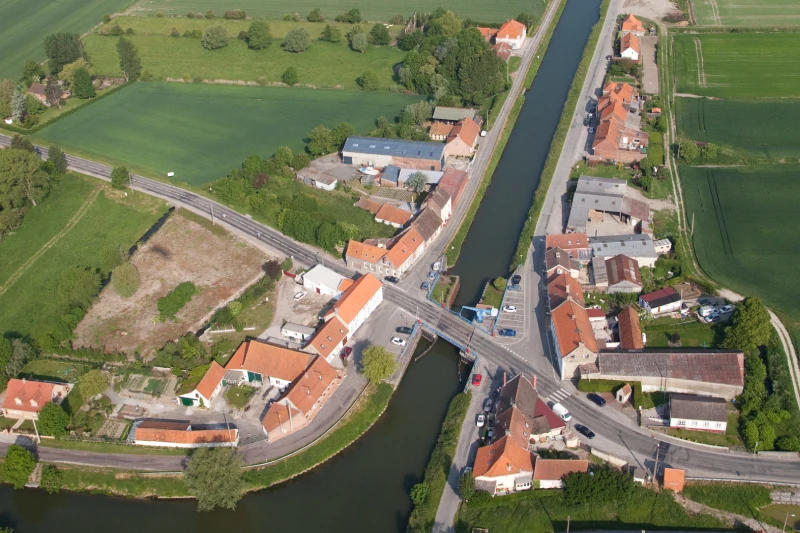
the Îlot d’Hennuin
The Îlot d’Hennuin is a preserved site located at the confluence of the Hem River and the Calais–Saint-Omer Canal. Owned by the waterways authority, the Îlot d’Hennuin was once used as a disposal area for dredged sediment. After settling, this material left behind a sandy substrate very rich in nitrogen. It was on this imbalanced soil that a willow grove developed.
An interpretation trail helps visitors understand the importance of water management in this region. The centre of the Îlot is a Nord Nature Chico Mendès site dedicated to environmental education.
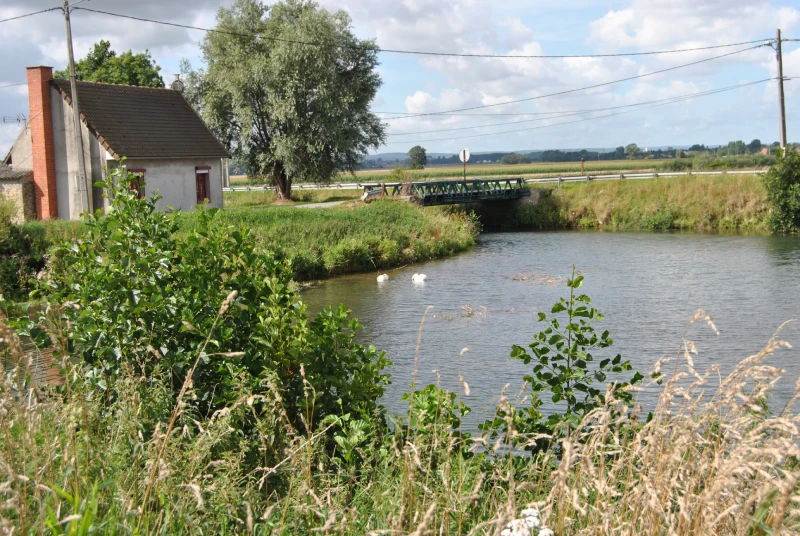
Le Grand Large
At this point, the Calais–Saint-Omer Canal, which is thirty kilometres long, makes a spectacular wide bend known as the ‘Grand Large’
Pumping station
Without the ingenious network of wateringues, the area would disappear beneath marshland. Fortunately, structures have been built by the wateringues authorities, such as this pumping station, which helps channel water from the watergangs into the canal.
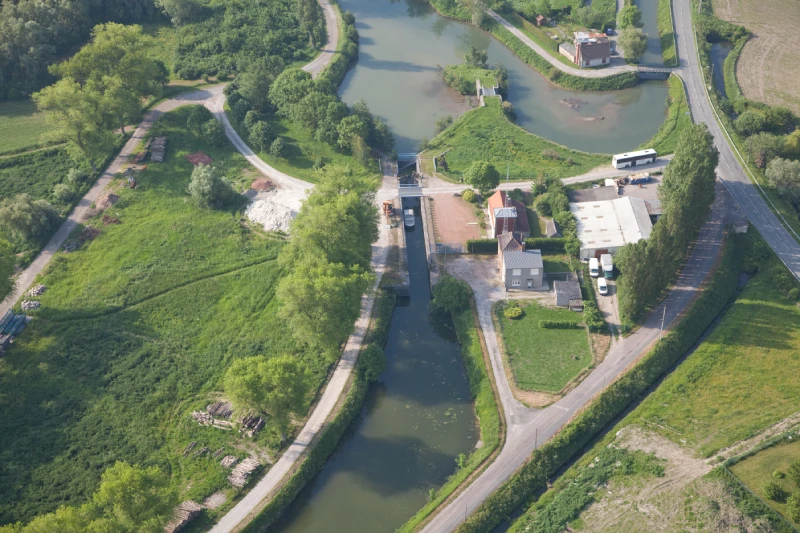
Former Hennuin Lock
A first lock was built in Hennuin in 1845. It is 42 metres long and 5.15 metres wide. It allowed the passage of barges measuring 38 metres in length and carrying up to 260 tonnes of freight. It is a traditional lock operated manually.
In the late 1980s, as part of the construction of the Channel Tunnel, a new lock was built to allow larger barges to pass through and to transport the materials needed for the Tunnel’s construction.