
Church of Ruminghem
Saint-Martin Church
Saint Martin was a Roman soldier. One day, in Amiens, he gave half of his cloak to a beggar. Jesus did not remain indifferent to this act of generosity, as he appeared the following night to the future saint, dressed in the cloak in question. This was the beginning of a great ecclesiastical career, based on the classic pattern of apparition-vocation-beatification.
Saint Martin, who later became Bishop of Tours, played an important role in the evangelization of Gaul, and several thousand churches in France bear his name today.
Notable elements
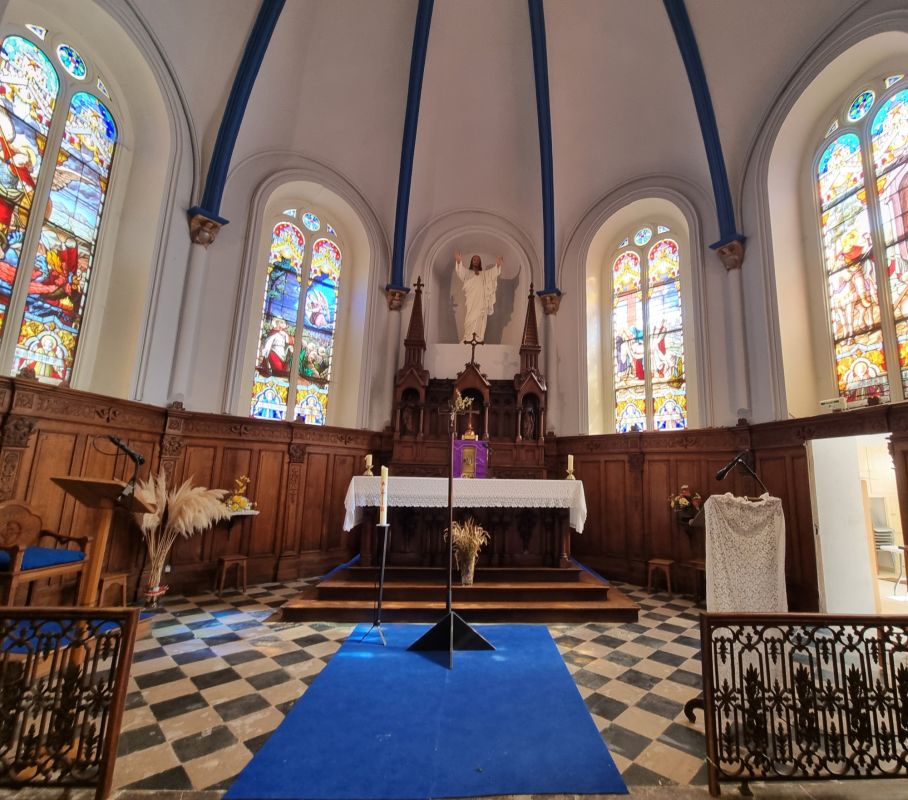
The baptismal font
made of Belgian marble, with a bronze cover. The altar is made of carved wood. On each side are statues of Saint Peter and Saint Paul.
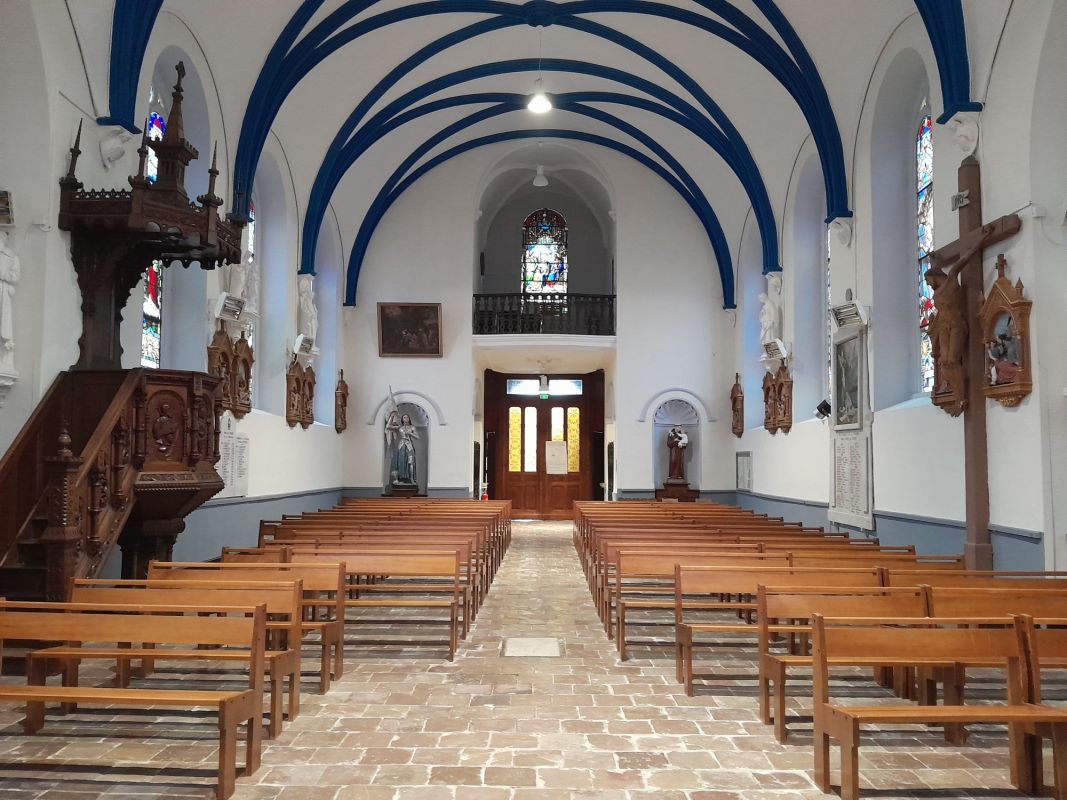
The pulpit
made of carved wood, it dates from the 19th century. It features 4 panels representing the 4 evangelists: St Matthew (man’s head), St John (the eagle), St Mark (lion’s head), St Luke (ox).
The stained glass
created by glassmakers from Tournai. Two are dedicated to St Martin. The others in the choir have as their themes St Michael slaying the dragon, the Agony of Jesus in the Garden of Olives, and the Descent from the Cross. In the nave, they represent the apparitions of the Sacred Heart to Marguerite Marie, St Joan of Arc and the Baptism of Clovis, the Annunciation, the Nativity, and the Resurrection.
The church bell tower
The bell tower was rebuilt as early as 1791, revealing the piety of the inhabitants. It is crenellated. This type of bell tower is also found in Polincove and Sainte-Marie-Kerque. The church was rebuilt in 1806. The nave and the choir are made of brick and rubble, while the two side chapels built around 1864 are made solely of white brick.
In 1821, the Bomart family obtained permission to build a calvary leaning against the bell tower. Louis Joseph Bomart was the mayor of the commune in 1806. He directed the reconstruction of the church and the presbytery.
A bit of history
The place was inhabited by the Morini before the Roman era, then crossed by Roman roads leading to Boulogne. A fortified castle was reportedly built there in the 4th century, and in 858 a church was erected 800 meters from this castle. At the time, this land of Ruminghem bore vineyards. It depended on the Abbey of Saint Bertin. In 1218, the priest of Ruminghem drowned while returning via the Aa from the feast of Saint Bertin, which he had heavily celebrated (drinking).
Shortly before his unfortunate bath, he was mocking the inhabitants of Saint-Omer, according to the chronicle of the time. During the siege of Saint-Omer in 1638, Count Piccolomini established his headquarters there. On August 2, 1639, Marshal de la Meilleray seized the castle of Ruminghem and razed it to the ground. In 1789, Ruminghem fell under the jurisdiction of the Bailiwick of Bailleul. The church was sold to demolishers (Caron, Gorillot, and Bézard) who resold the materials. It was in 1806 that the 877 inhabitants of Ruminghem regained their church.