Church of Nortkerque
Saint Martin’s Church
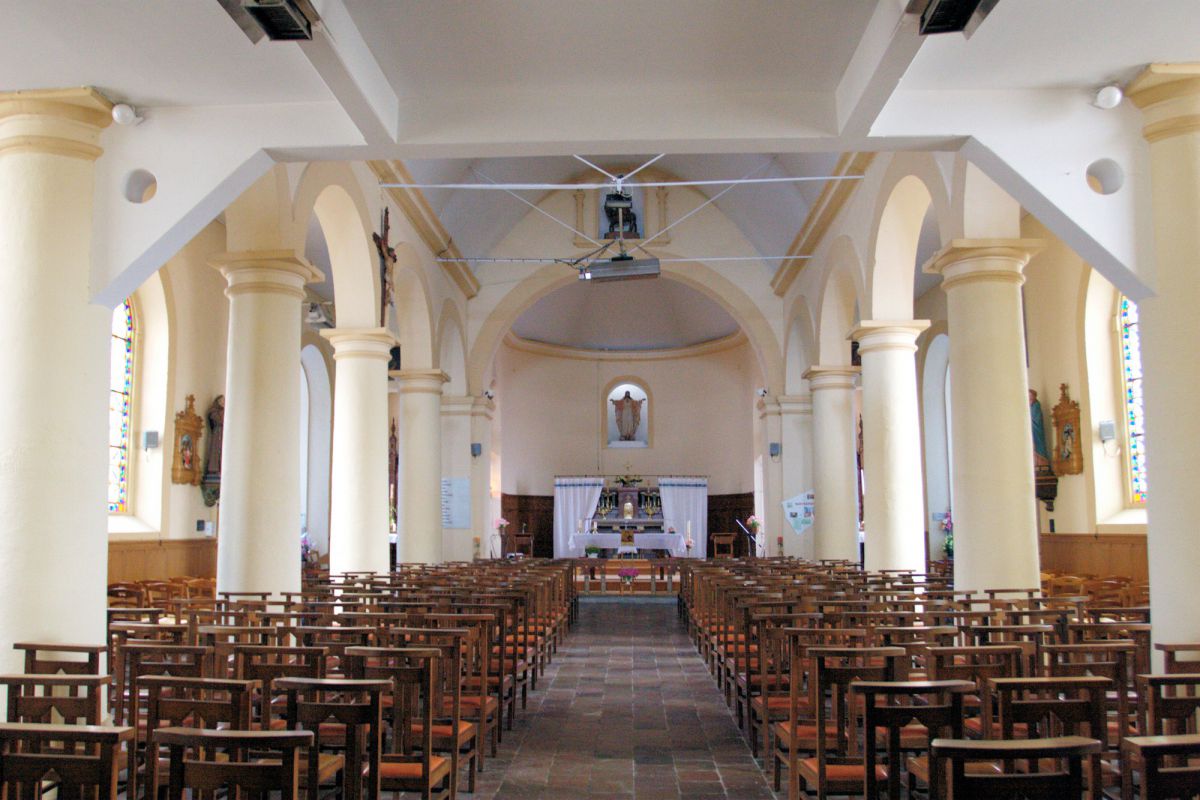
The building follows a rectangular plan for the central nave and the side aisles, while the narrower chancel ends in a three-sided apse. These elements are clearly visible from the exterior thanks to the different colouring of the walls.
It is built of local red and yellow bricks from Brêmes, with a slate roof. Above the doorway is a mosaic decoration, probably originating from Wisques Abbey.
It depicts the Paschal Lamb resting upon the seven seals, with the following inscription:
« quam dilecta tabernacula tua dominé virtutum »
(How lovely is your dwelling place, Lord of hosts)
Notable features
The altar of Notre Dame de la Pitié.
The Pieta is a representation of the Virgin mourning her Child. It was purchased in 1919 using the remaining funds from donations made by parishioners for the erection of the calvary, in tribute to the victims of war. The statue is placed on top of the granite pulpit.
The pulpit
Used for preaching and for commenting on the Gospel of the day, it features the sculpted symbols of the four Evangelists, John, Matthew, Mark and Luke, as well as Christ and, behind the priest, the dove of Peace. At the lower sides are the symbols of the Eucharist, with ears of wheat and grapes. Traditionally, the pulpit is located to the right of the altar. However, Abbé Flandrin, curious by nature, had it moved to the left beneath the Crucifix so that he could see latecomers as they arrived. Later, in the 1990s, when it was no longer in use, it was placed against the right-hand wall.
Arc de Triomphe
In the cemetery stands a triumphal arch dating from 1753, marking the entrance to the presbytery.
The Art Deco bell tower of Nortkerque.
The bell tower shows an undeniable resemblance to the Officers’ Services Building at the Port of Calais, designed by Poyé in 1931. This architect was also responsible for the former maternity hospital and the labour exchange in Calais. The concrete crowning imitates a recessed flight of steps, creating an upward movement towards the sky from which the cross stands out.
The Art Deco style emerged between 1925 and 1928. It is characterised by the use of simple geometric forms and volumes, flat surfaces inspired by Cubism, and designs made easy to produce thanks to mastery of concrete. By commissioning Poyé, Abbé Flandrin proved to be progressive in the field of art. One can imagine that he must have had great talent and strong conviction to succeed in having this choice accepted by the people of Nortkerque.
Long a peat marsh, the territory of Nortkerque was drained from the 12th century onwards. A first church was built in 1269 by Arnoul III, Count of Guînes, in thanksgiving for his return from ten months of captivity in Holland during a conflict with William II of Holland. The church was looted and then destroyed in 1595 by Henry IV during his campaign in Artois. It was rebuilt in 1642. During the French Revolution, it was sold to three demolition contractors from Arras, who specialised in the resale of building materials.
A bit of history
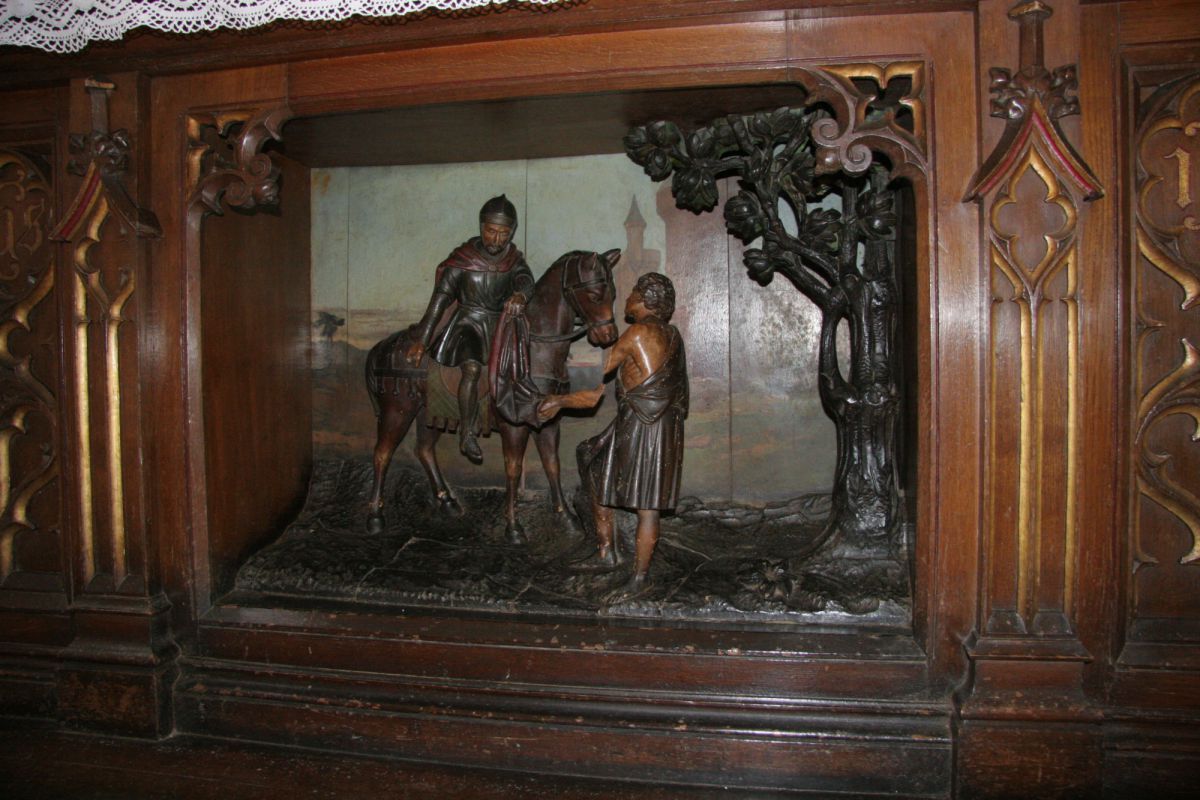
Saint Martin was a Roman soldier. One day in Amiens, he gave half of his cloak to a beggar. Jesus was not indifferent to this act of generosity and appeared the following night to the future saint, wearing the cloak in question. This marked the beginning of a great ecclesiastical career, following the classic pattern of apparition, vocation and beatification. Saint Martin later became Bishop of Tours and played an important role in the evangelisation of Gaul. Today, several thousand churches in France bear his name
Opening hours
Moday : 10:00 am – 5:00 pm
Tuesday : 10.00 am – 5:00 pm
Wednesday : 10.00 am – 5:00 pm
Thursday : 10.00 am – 5:00 pm
Friday : 10.00 am – 5:00 pm
Saturday : 10.00 am- 5:00 pm
Religious services:
Sunday : 11:00 am