
Church of Muncq-Nieurlet
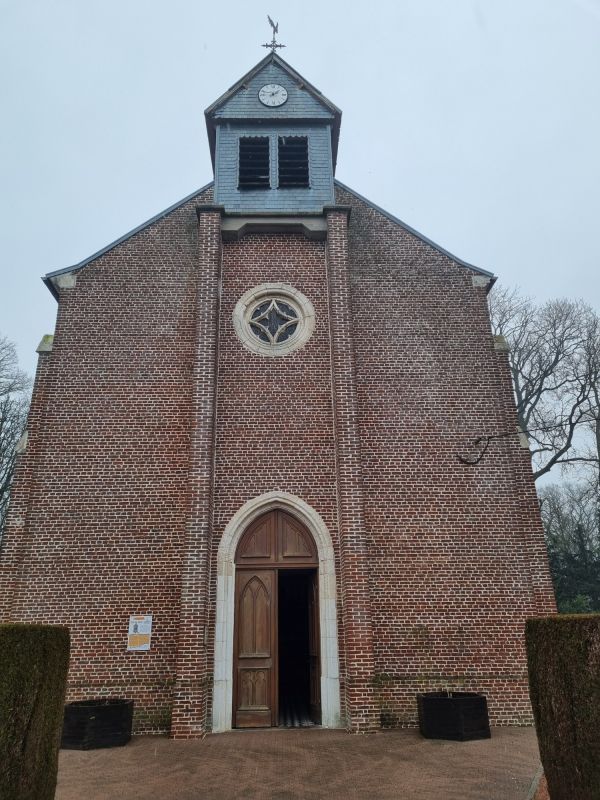
Saint Joseph’s Church in Muncq-Nieurlet, a 19th-century building, welcomes visitors to discover its Neo-Gothic architecture and rich local heritage.
Saint Joseph’s Church
Saint Joseph’s Church was built in 1862, during the Second French Empire, by the Delattre Bernet family on land they owned. Its construction forms part of a wider movement to create new parishes in the Calais area between 1820 and 1881. The Delattre Bernet family was that of Monsignor Evrard, Bishop of Meaux and a native of the commune.
Notable features
L'autel
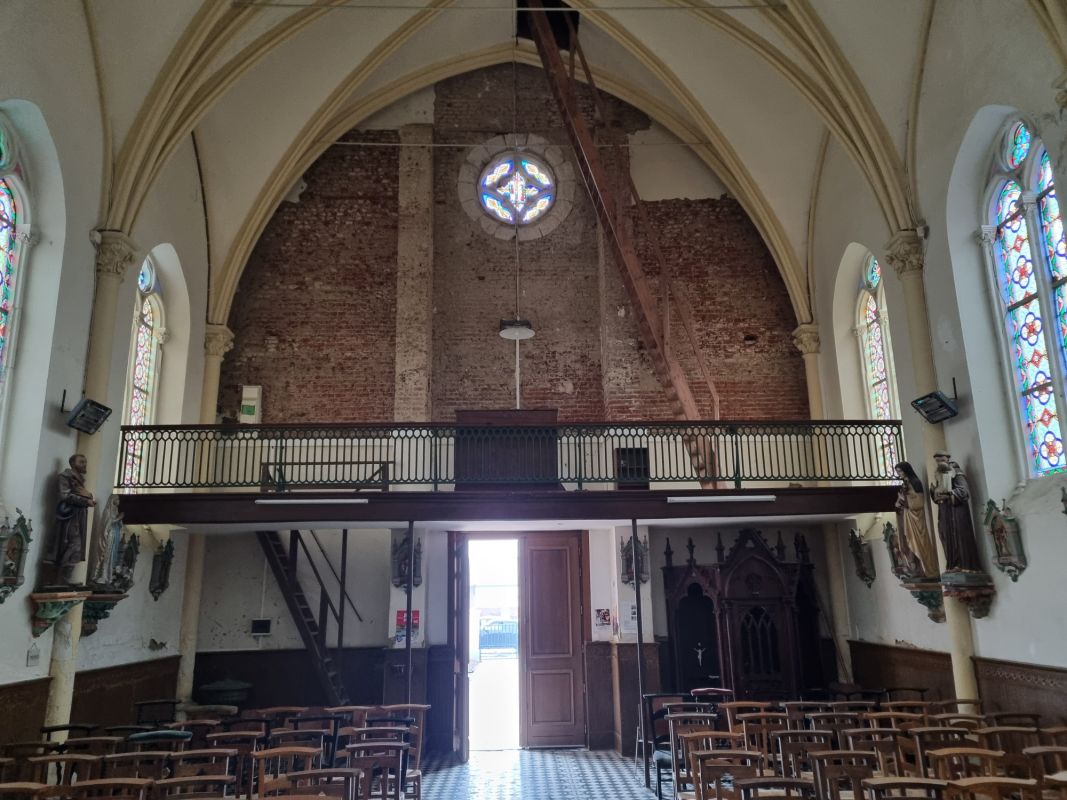
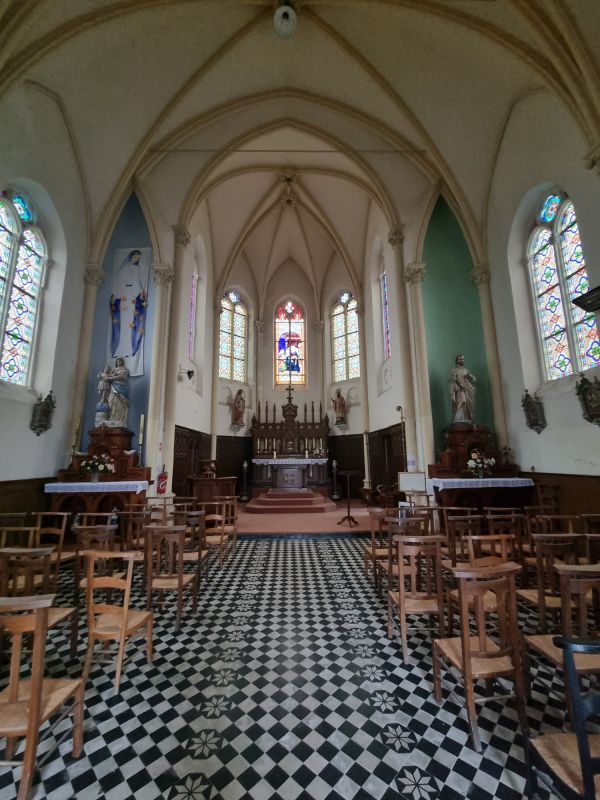
The altar, the Stations of the Cross and the statues date from 1862.
The main stained-glass window was shattered by the storm of 25 January 1990. It was reproduced identically to the original by Luc-Benoît Brouard in 1996.
Monsignor Evrard
Monsignor Evrard was born in Muncq-Nieurlet on 8 May 1889 into a farming family. He entered the Saint-Sulpice Seminary in 1905. He received the minor orders in 1908, was ordained subdeacon in 1912, and in 1914 became a lecturer at the Major Seminary of Arras. During the First World War, he served as a stretcher-bearer chaplain. He was taken prisoner in 1916 while rescuing wounded soldiers and was awarded the Croix de Guerre and the Military Medal for his courage. In 1919, he resumed his duties as both professor and bursar at the Major Seminary of Arras. In 1929, he was appointed parish priest of Bruay-en-Artois. In June 1933, he became archpriest of Calais and dean of the Church of Our Lady. His qualities as a man of the Church drew the attention of the Holy See, which appointed him Bishop of Meaux in February 1937. He proved to be more of a pastor than an administrator and was ahead of his time in his approach to people
He fell ill, which forced him to resign in 1942 after a long period of convalescence. He was then given the title of Bishop of Dionysopolis. Once recovered, he returned to the Diocese of Arras as a ‘missionary’, with the ambition of preaching in every parish of the Pas-de-Calais. In 1954, he moved to a retirement home in Saint-Omer, where he died in 1974 at the age of eighty-five. His funeral took place at Saint-Omer Cathedral on 3 October, with the homily delivered by Monsignor Huyghes, Bishop of Arras. He was buried in Calais at the South Cemetery and was transferred in 2012 to Notre-Dame de Calais.
Saint Joseph’s Church was built by the family of Monsignor Evrard. The coat of arms of Meaux, along with the effigies of Saint Augustine, Saint Marcel and the Pope, appear in the corbel at the top. After his death, the Evrard family bequeathed his gilded crozier to the church. This crozier is still on display there today.
The earliest records of the village date back to 1145, when it was known as NIWERLEDE. In 1460, it was called MONCQUIEWERLET. By 1720, it appears under the name MUNCQ-NIEURLET. Monks had passed through the area and a river was dug, giving rise to the name MUNCQ (monks) and NIEURLET (new river). There is no record of a church before the 19th century
Chapel of Notre-Dame des bois
This chapel was built in 1863 on a raised clearing bordered by trees, at the edge of the Recques woodland, on a site that was very dear to Monsignor Evrard. The celebration of his sixty years of priesthood took place in this chapel in 1972.
Inside, there are many expressions of popular devotion, mainly dating from the 1950s. The chapel is built of brick. Its façade is particularly striking, with decorative brickwork highlighted by white paint, from which the words ‘Ave Maria’ stand out. The roof is topped with a small bell tower.
Chapel of Notre-Dame des Bois
Joseph était artisan charpentier, il est fiancé à Marie lorsque celle-ci se retrouve enceinte par l’action du Saint- Esprit. Il épouse quand même Marie et devient le père nourricier de Jésus. Il est représenté comme un homme juste qui a accepté d’accueillir Marie et son enfant en toute connaissance de cause. On pense qu’il est décédé avant l’entrée de Jésus dans la vie publique.